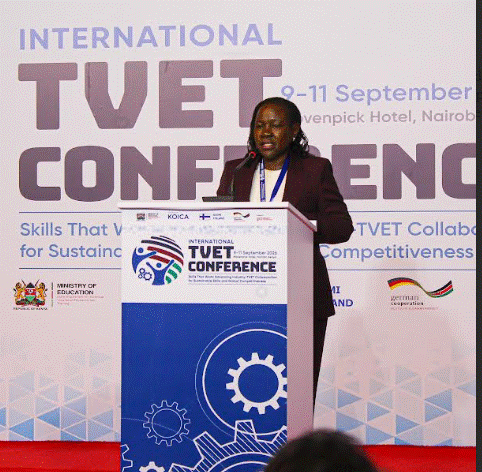
Kenya is repositioning Technical and Vocational Education and Training (TVET) and placing industry at the centre of skills development, with the Government seeking to ensure graduates acquire competencies that match labour-market demands and support industrialisation.
Principal Secretary, State Department for Technical and Vocational Education and Training (TVET), Dr. Esther Thaara Muoria, said the Government was moving beyond classroom-based training by bringing industries into TVET institutions and expanding opportunities for learners to gain practical experience using real equipment and production environments.
Muoria said the approach was anchored on the principle of “training from industry, with industry, for industry”, with institutions expected to work more closely with employers in curriculum development, training, innovation and production.
She said Kenya had established 33 national polytechnics and 217 technical and vocational colleges, while 11,600 trainers had been trained in competency-based training and about 300 modularised curricula developed or reviewed.
Muoria said green competencies had been incorporated into 86 curricula, more than 2,500 companies engaged with TVET institutions and more than 15,000 young people had benefited from dual training.
She said the country had also approved the Dual Training Policy in January 2025, strengthening a model that combines institutional learning with workplace training.
The PS said the Government was now taking the approach further by establishing production and service facilities within TVET institutions, citing initiatives in agriculture, apparel manufacturing and automotive repair.
“This is about bringing industry into our institutions so that our learners train in environments that reflect the realities of the workplace,” she said.
Muoria, speaking in Nairobi on Wednesday during the International TVET conference, noted that Finland, Germany and South Korea had committed about 28 million euros to the country’s TVET sector, complemented by KOICA support for infrastructure, equipment and technical expertise.
She said Kenya was implementing the Kenya-Germany Migration and Mobility Partnership, with labour mobility expected to facilitate skills transfer while ensuring recruitment remained safe, ethical and transparent.
Ambassador of the Republic of Korea to Kenya, Kang Hyung-shik, said Korea’s own economic transformation demonstrated how investment in education, technical skills and research could support industrial growth.
Kang said Korea was working with Kenya through the Korea International Cooperation Agency (KOICA), the National Industrial Training Authority (NITA) and other partners to strengthen the country’s workforce, particularly in areas linked to infrastructure and manufacturing.
He said TVET should prepare young people for emerging industries while encouraging stronger investment by the private sector.
“Connecting TVET with investment and job creation is very critical and vital,” Kang said, urging Korean businesses to deepen industrial partnerships in Kenya.
Ambassador of Finland to Kenya, Riina-Riikka Heikka, said quality training, private-sector participation and inclusion were critical to building an effective TVET system.
Heikka said Finland was supporting Kenya through the Promotion of Youth Employment and Vocational Training programme, jointly funded with Germany and implemented by GIZ in partnership with the State Department for TVET.
She said employers should participate in curriculum development, workplace training and assessment to ensure graduates acquire skills relevant to the changing economy.
“Teachers really are the backbone of any education system, and TVET is no exception,” Heikka said.
She called for greater participation of women and persons with disabilities in technical training, noting that social attitudes and other barriers continued to limit access to some occupations.
Deputy Ambassador of Germany to Kenya, Konrad Lax, said Germany’s experience with dual training demonstrated the importance of allowing companies to play a direct role in skills development.
Lax said about 15,000 TVET students in 120 institutions were being trained in partnership with 1,500 industry partners, giving learners exposure to workplace equipment and practical expertise.
He urged companies to become “architects of training”, saying they were best placed to identify emerging technologies and skills gaps.
“Companies are the first to know where technology is heading, and which skills are missing,” Lax said.
He highlighted Kenya-Germany labour mobility initiatives, saying managed movement of skilled workers could benefit both countries while promoting skills development and knowledge exchange.
The three-day International TVET Conference 2026, which began in Nairobi on Wednesday, brings together government, industry, training institutions, development partners and international experts to examine ways of making skills development more responsive to employment and industrial needs.
The conference, organised by the Ministry of Education, State Department for TVET, is being held under the theme “Skills That Work: Advancing Industry-TVET Collaboration for Sustainable Skills and Global Competitiveness.”
by Sharon Njeru and Tonny Omollo